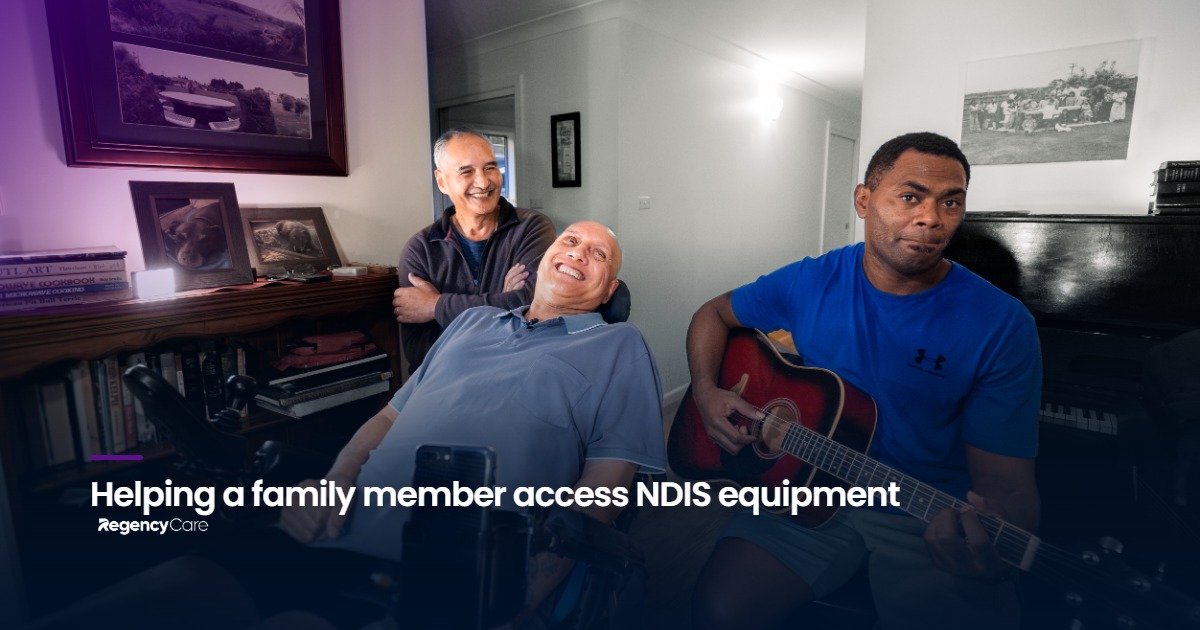
Helping a family member access NDIS equipment: where to start
Caring for someone you love comes with a long list of things you never expected to learn, and the NDIS is often one of them. Working out how to get NDIS equipment for a family member can feel overwhelming when you are already stretched. Take a breath. This guide walks you through where to start, in plain language, one step at a time.
Is your family member eligible for funded equipment?
Start with the basics. If your family member is an NDIS participant, equipment that relates to their disability and helps them live more safely or independently can usually be funded.
The equipment has to meet what the NDIS calls the reasonable and necessary test. In everyday terms, it needs to be genuinely linked to their disability, help them do daily life, and represent fair value. You do not need to prove all of this yourself, and that is what the next step is for.
If your family member is not yet an NDIS participant, the first step is getting access to the scheme rather than choosing equipment. A GP or an OT can help gather the evidence for an access request. Once they are in the scheme, the equipment path opens up, and the rest of this guide applies.
The role of an OT assessment
An occupational therapist, or OT, is your ally here. They assess what your family member can and cannot do, recommend the right equipment for their circumstances, and write the report the NDIS needs to approve funding.
To request one, ask your Support Coordinator, or ask your plan manager or the NDIS directly if you do not have a coordinator. If your family member does not yet have OT funding in their plan, that is worth raising too. A good assessment saves time and gets the right equipment the first time.
What types of equipment the NDIS can fund
The NDIS funds a wide range of assistive technology. Common examples include wheelchairs and mobility scooters, electric adjustable beds, patient lifters and hoists, shower commodes, and pressure care equipment.
The point is not to memorise a list. It is to notice where daily life is hard or unsafe, whether that is moving around, transferring, bathing or sleeping, and to bring those observations to the OT.
How to choose a supplier
Not all suppliers are the same, and the right one makes the whole process easier. Look for an NDIS-registered supplier who supplies and services the equipment, so you are supported after delivery, not just at the sale.
Ask how they handle assessments, delivery, servicing and repairs. Ask whether they will work with your OT. A supplier who answers your questions patiently is one worth keeping. It is also fine to ask other families or your OT who they trust, because a recommendation from someone who has been through it is worth a lot.
What happens after the equipment arrives
Getting the equipment is not the finish line. It needs to be set up correctly, and it needs to be maintained so it keeps working safely over time.
Ask about servicing from the start. Equipment like hoists, wheelchairs and beds needs regular checks, and a maintenance program keeps it safe and gives you documented history for future plan reviews.
You do not have to figure this out alone
This process has a lot of moving parts, and nobody expects you to become an expert overnight. Lean on your OT, your Support Coordinator, and a supplier who genuinely helps. Regency Care supports families through every step of accessing and maintaining NDIS equipment.
Where to start, simply
Learning how to get NDIS equipment for a family member comes down to a few clear steps: check eligibility, get an OT assessment, choose a good supplier, and plan for maintenance. Take it one step at a time, and ask for help when you need it.